Prefer listening to this article ? Hit play below to enjoy the audio version of this article.
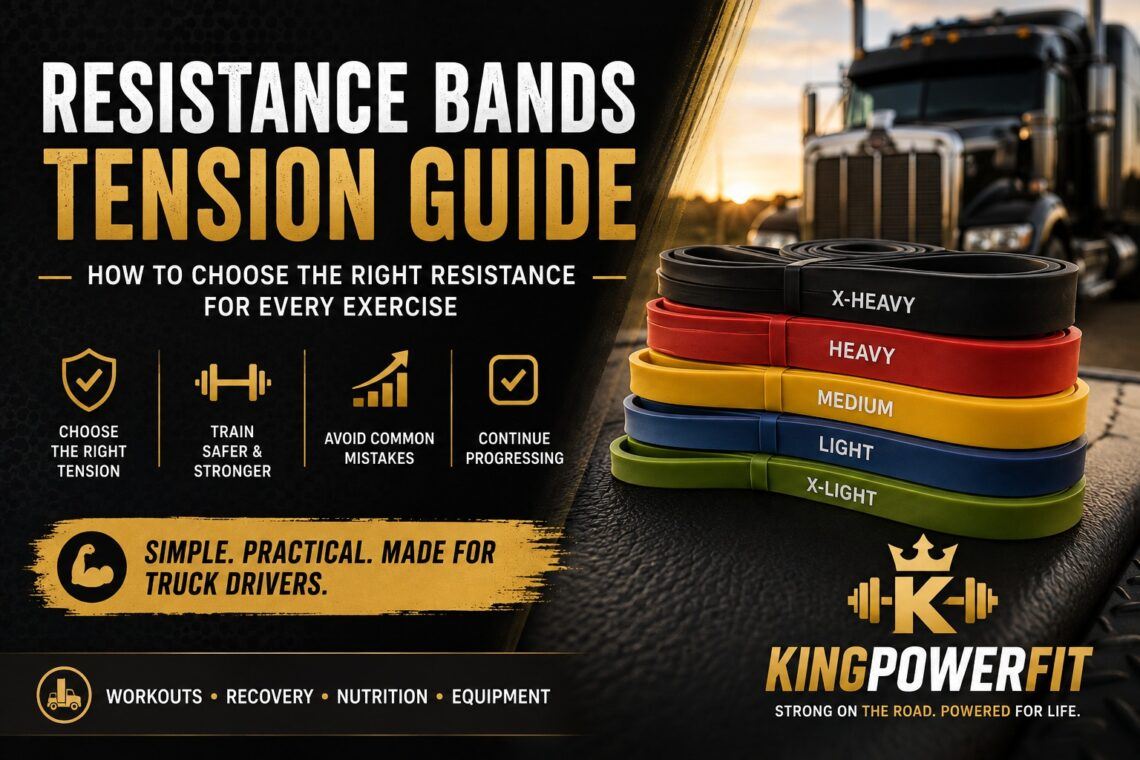
Resistance Bands Tension Guide: How to Choose the Right Resistance for Every Exercise
Buying a set of resistance bands is the easy part. Knowing which band to use is where many beginners become confused.
Should you start with the lightest band? Does the colour matter? Should you always use the heaviest resistance possible to build muscle?
As a full-time truck driver and former personal trainer, I’ve used resistance bands in truck stops, loading docks, at home and in the gym. The best resistance band that works best for me isn’t necessarily the strongest one—it’s the one that allows you to train with proper technique while challenging your muscles.
This resistance bands tension guide will help you understand how to choose the right resistance for every exercise, avoid common mistakes and continue progressing as you become stronger.
If you’re still wondering whether resistance bands can actually build muscle, you may also enjoy my guide on Can Resistance Bands Build Muscle? where I explain the science behind muscle growth using resistance bands.
What Does Resistance Band Tension Mean?
Resistance band tension refers to the amount of force the band produces as it stretches.
The more you stretch the band, the more resistance it creates.
Unlike free weights, resistance bands provide variable resistance, meaning the tension increases throughout the movement. This creates a unique training stimulus and keeps your muscles working through the entire range of motion.
Choosing the correct tension allows you to perform each exercise safely while still providing enough resistance to encourage muscle growth and strength improvements.
Why Choosing the Right Resistance Matters
Choosing the correct resistance is only one part of the equation. Following a structured workout routine is just as important. If you’re short on time, my 30-Minute Workout Plan for Truck Drivers shows exactly how I use resistance bands during busy workdays.
Many people believe using the strongest band will produce the fastest results.
Unfortunately, that’s one of the biggest mistakes beginners make.
If the resistance is too heavy:
- Your technique often breaks down.
- You may compensate using momentum.
- Your range of motion becomes limited.
- Your risk of injury increases.
If the resistance is too light:
- Your muscles aren’t challenged enough.
- Progress becomes slower.
- Workouts become less effective.
The goal is to find the balance between challenge and control and most importantly which bands is best suitable for certain exercises.
Every repetition should feel difficult by the end of the set, but your technique should remain consistent from start to finish.
Do Resistance Band Colours Mean Anything?
This is probably one of the most common questions people ask.
The answer is yes—but only within the same brand.
Different manufacturers use different colour systems.
For example:
- A black band from one company may provide completely different resistance than a black band from another.
- A blue band from one brand may actually be heavier than a green band from another.
Instead of focusing on colour alone, always check the resistance level provided by the manufacturer.
Think of colours simply as an easy way to identify different resistance levels within that particular set.
How to Choose the Right Resistance Band
One of the easiest methods is to use your target repetition range as your guide.
For Strength
Choose a resistance that allows approximately:
6–10 repetitions
The final few repetitions should feel challenging while maintaining good technique.
For Muscle Growth
Aim for approximately:
8–15 repetitions
This range allows enough resistance to stimulate muscle growth while maintaining excellent control.
For Muscular Endurance
Use lighter resistance for:
15–20+ repetitions
This works well for rehabilitation, mobility work, posture exercises and recovery sessions.
If you’re unsure which resistance band to use, it’s also important to understand the different types of resistance bands and what each one is designed for. Choosing the right style of band can make your workouts safer, more effective and better suited to your training goals.
Use the Rep Test
A simple rule I often use is the Rep Test.
Ask yourself:
- Could I easily perform another 10 repetitions? → The band is probably too light.
- Could I complete my target repetitions with good technique? → The resistance is about right.
- Did my technique fail after only a few repetitions? → The resistance is probably too heavy.
You don’t need complicated calculations.
Your body will usually tell you whether you’ve selected the correct resistance.
Resistance Bands Tension Guide by Exercise
Different muscles require different levels of resistance.
Here’s a general guide to help you get started.
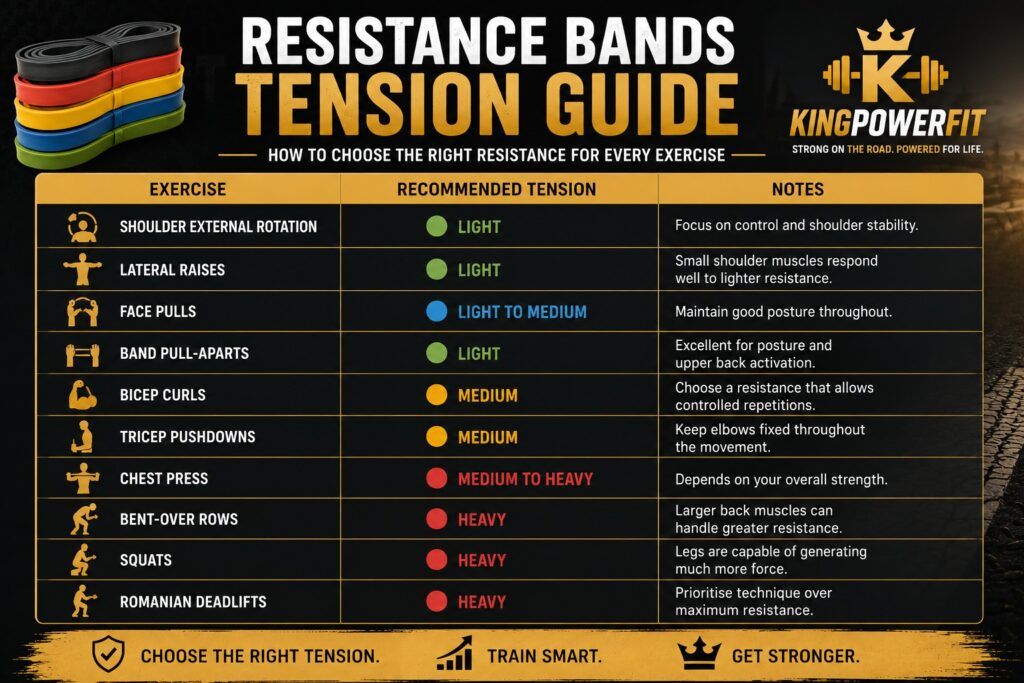
Remember, these are only starting points.
Everyone’s strength is different.
If you’re looking for practical examples of these exercises, check out my Resistance Bands Workout in the Cab where I demonstrate movements you can perform while waiting at loading docks or during breaks.
Progressive Overload Still Applies
Resistance bands follow the same principles as weight training.
If your workouts become easier over time, your body has adapted.
To continue making progress you can:
- Move to a stronger band.
- Combine two resistance bands.
- Perform additional repetitions.
- Slow down each repetition.
- Add another set.
- Reduce rest periods when appropriate.
Small improvements performed consistently lead to long-term results.
Common Mistakes to Avoid
Many beginners make the same errors.
Try to avoid:
- Choosing resistance based only on colour.
- Starting with bands that are too heavy.
- Using momentum instead of controlled movement.
- Allowing the band to snap back quickly.
- Ignoring full range of motion.
- Never increasing the challenge as you become stronger.
Good technique will almost always outperform heavier resistance with poor form.
My Advice for Truck Drivers
As someone who spends long hours behind the wheel, I understand that convenience often determines whether a workout happens at all.
When I’m training during a truck stop break or waiting at a loading dock, I don’t worry about using the heaviest resistance available.
Instead, I choose a band that allows me to perform each movement with control while making the final few repetitions challenging.
That approach has helped me stay consistent despite working long days.
If you’re a truck driver or someone with a busy schedule, remember that consistency is far more important than chasing maximum resistance.
A well-performed 20 to 30-minute workout using the correct band will almost always provide better results than rushing through heavy resistance with poor technique.
Frequently Asked Questions
Which resistance band should beginners start with?
Most beginners benefit from starting with a lighter or medium resistance band. This allows you to learn proper technique before progressing to heavier resistance.
Can I build muscle using lighter resistance bands?
Yes.
As long as you’re training close to muscular fatigue and progressively increasing the challenge over time, resistance bands can be an effective tool for building muscle.
Can I combine resistance bands?
Absolutely.
Many experienced users combine two bands together to create additional resistance without needing an entirely new band.
Should every exercise use the same resistance band?
No.
Different muscle groups require different amounts of resistance. It’s completely normal to switch between several bands during the same workout.
Recommended Products
Choosing the right equipment can make your resistance band workouts more effective and enjoyable. Here are a few products I recommend if you’re building a simple home or travel training setup.
- Long Loop Resistance Band Set – A complete set with multiple resistance levels gives you the flexibility to perform a wide variety of exercises and progress over time.
- Resistance Band Door Anchor – Adds even more exercise options by allowing you to securely anchor your bands to a door.
Final Thoughts
Choosing the right resistance band isn’t about selecting the thickest band or following a particular colour.
It’s about finding the resistance that challenges your muscles while allowing you to maintain good technique from the first repetition to the last.
Use this resistance bands tension guide as a starting point, experiment with different resistance levels and don’t be afraid to progress as your strength improves.
Whether you’re training at home, in the gym or during a truck stop break, selecting the right resistance will help you get more from every workout while reducing your risk of injury.
At the end of the day, the best resistance band is the one that keeps you training consistently. Progress doesn’t come from using the heaviest band—it comes from showing up, training with purpose and gradually getting stronger over time.